White Paper  ·  Asset Integrity Intelligence

RBI is only as strong as
the evidence that feeds it.

A technical paper on how high-density robotic inspection data strengthens CUI risk models — sharper Probability of Failure inputs, defensible decisions for regulators and insurers, and one repeatable methodology across a portfolio.

Enhancing Risk-Based Inspection for Corrosion Under Insulation — ARIX white paper

Trusted by the world's largest operators

White Paper · 27 Pages

Read the full paper.

From the paper

Enhancing Risk-Based Inspection for Corrosion Under Insulation with High-Density Digital Inspection Data

How ARIX Technologies improves CUI inspection with a repeatable data source for stronger risk models, defensible decisions, and enterprise-wide integrity management.

Joe Bourgeois, SVP Global Sales Eric Mehl, Commercial Director — Europe Petter Wehlin, Technical Product Manager & Co-Founder

Abstract

Corrosion Under Insulation (CUI) is one of the process industries’ most persistent integrity threats and one of the hardest to manage through conventional sample-based inspection. Risk-Based Inspection (RBI), guided by API RP 580 and 581, is a sound framework for allocating inspection resources by probability and consequence of failure — but for CUI, its performance is limited by the quantity, consistency, and representativeness of the evidence available to validate degradation assumptions and update Probability of Failure (PoF).

ARIX® Technologies’ VENUS robotic platform removes that limitation: high-density Pulsed Eddy Current (PEC) and Real-Time Radiography (RTR) scanning, paired with georeferenced digital reporting, produces a far denser, more consistent inspection dataset — without scaffolding or insulation removal. This paper explains how that dataset strengthens existing RBI programs: sharper inspection targeting, more defensible risk decisions, and a consistent methodology across sites and portfolios. Robotics supplies the evidence RBI needs to become more accurate, repeatable, and economically scalable.

RBI is the accepted framework for prioritizing mechanical integrity because it focuses resources where risk is highest. For CUI, however, that decision is often based on indirect risk factors and a small number of inspection locations — not because the RBI philosophy is flawed, but because scaffolding, insulation removal, inspection, disposal, and reinstatement have historically been costly and disruptive.
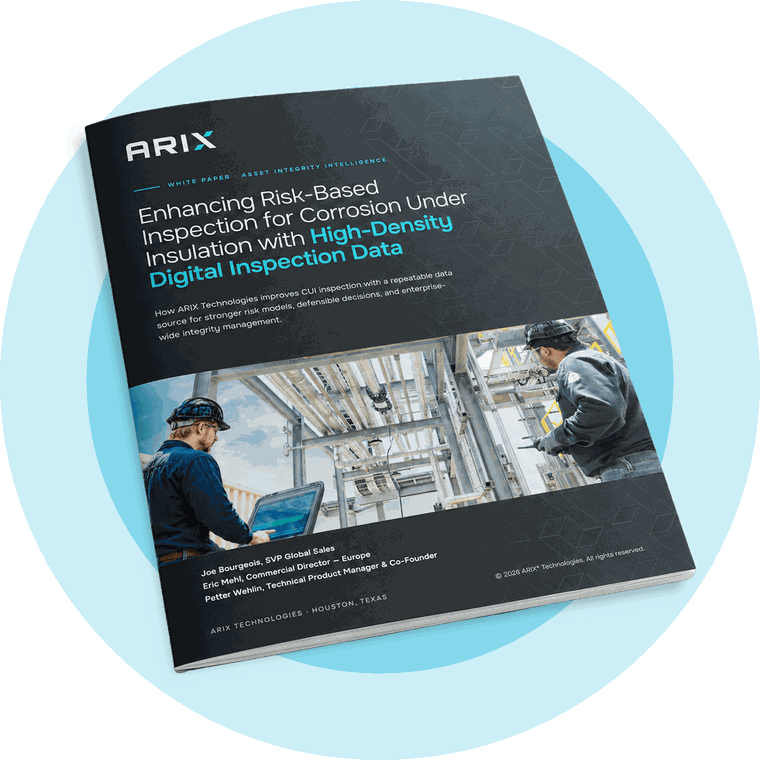

The full 27-page paper continues with the industry failure analysis, the ARIX inspection model, and the six controls that make robotic CUI evidence defensible.

Read the full paper

Who you'd be working with

Built by the industry, for the industry.

ARIX was founded in 2017 by engineers who had spent years on both sides of the problem. Today, we're helping customers improve worker safety and make smarter asset integrity decisions through robotic inspections and actionable data. The company is headquartered in Houston and works with oil and gas, petrochemical, and power companies.

Prefer to talk it through?
Book a field walk.